
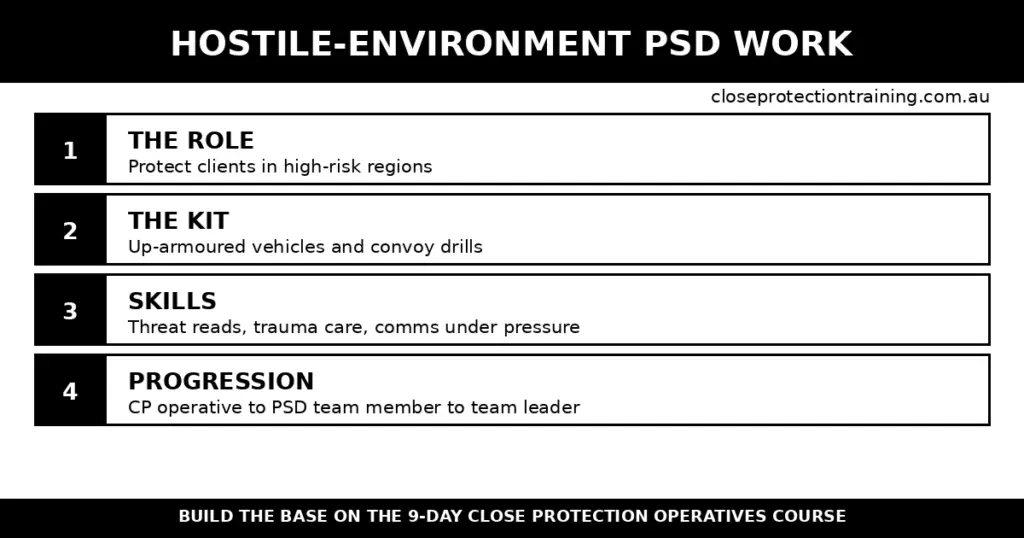
Short answer: A close protection career can lead to hostile-environment work. This is PSD work – protective security detail – in high-risk places overseas. Teams often move in up-armoured vehicles. It is demanding and well paid. It also needs strong skills and a cool head. You build toward it over time. You start with a recognised course, gain experience, then step up to PSD teams. Panoptic’s 9-day Close Protection Operatives Course builds the base.
What is hostile-environment PSD work?
PSD stands for protective security detail. Hostile, or non-permissive, means the place is high-risk. Think conflict zones, unstable regions or remote sites. You protect clients like aid workers, engineers, media crews or executives. Teams often use up-armoured vehicles and travel in convoys. The work is serious. So is the training behind it.
Where does the travel take you?
This work is global. Your home base might be a city like Sydney, Perth or Brisbane. From there, tasks can send you to high-risk regions overseas. You may work far from home for weeks at a time. Australia also has vast, remote areas. So some austere-environment work happens here too.
What does progression look like?
- CP operative. Build core close protection skills at home.
- PSD team member. Join a detail in a higher-risk setting.
- Team leader. Plan tasks, run the team and own the risk.
You do not jump straight into hostile work. You earn it. Extra training in trauma care, comms, weapons and vehicle drills all helps. So does a strong, trusted reputation.
How do you get there?
Start with the core skills. You need a Certificate III in Close Protection Operations and a state security licence. Panoptic’s 9-day live-in course gives you four nationally recognised qualifications, through Asset College (RTO 31718). It covers threat and risk reads, first aid and trauma care, comms, and a live-fire (Category H) range. Its instructors come from the SAS Regiment, Commandos, Military Police close protection and Police Tactical Groups. From there, build experience and add advanced skills. Read how to get into the bodyguard industry. Work is never guaranteed.
Key takeaways
- Hostile-environment PSD work protects clients in high-risk regions, often in up-armoured vehicles.
- It is global work and can take you far from home for long stretches.
- Progression runs from CP operative to PSD team member to team leader.
- You build the base on a recognised course, then add experience and advanced skills.
Ready to build the base? Book your place on the Close Personal Protection (CPP) course.
