
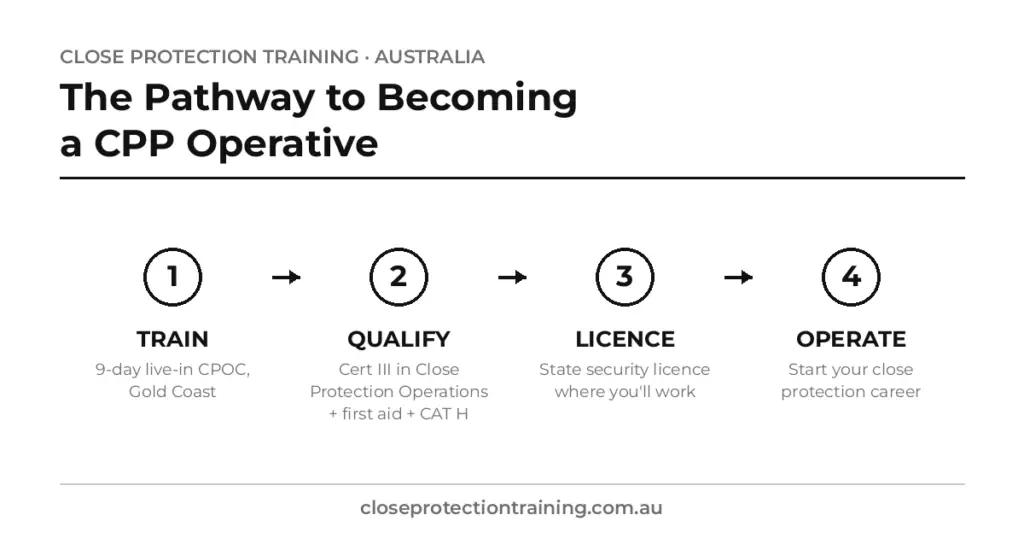
Short answer: To become a close protection operative in Australia, you need three things. You need a Certificate III in Close Protection Operations. You need a state security licence. And you need real, hands-on training. The fastest route is a nationally recognised course, like Panoptic Solutions’ 9-day live-in Close Protection Operatives Course on the Gold Coast. Qualifications are issued through our training partner, Asset College (RTO 31718).
Bodyguarding is really called close protection, or Close Personal Protection (CPP). It is a licensed job in Australia. So the path in is clear. Get qualified. Get licensed. Then build real skill on the ground. Here is how each step works.
What qualifications do you need?
You need a few core credentials. The main one is a Certificate III in Close Protection Operations. This is the qualification behind a bodyguard licence in Australia. You also need first aid, ideally advanced first aid with trauma training. And you need a Firearms Safety certificate (Category H) if the role uses firearms. Want the full list? Read what qualifications you need for CPP work.
Do you need a licence?
Yes. Close protection is licensed by each state and territory. You apply for a security licence in your home state. The Certificate III is the training base for that licence. The rules differ a little between states. So check your local security regulator before you apply.
What is the fastest way in?
The quickest route is one complete course. Panoptic’s 9-day live-in CPP course covers it in one block. You live on site on the Gold Coast. You earn four nationally recognised qualifications. You also get real scenario practice. Want the day-by-day plan? Read what happens during the 9-day CPP course. The course fee is $8,602 (inc. GST). Ex-service, police and first responders pay $7,820. See how much CPP training costs.
Do you need experience?
No. You do not need experience to start. The course suits new people. It also suits skilled operators who want to fill gaps. A background in the military, police or emergency services can help. But it is not required. Not sure you are fit enough? Read how fit you need to be.
Where do CPP operatives work?
Panoptic runs the course on the Gold Coast. Graduates then work right across Australia. This includes Sydney, Melbourne, Brisbane, Perth and Adelaide. It also includes the Sunshine Coast, Newcastle, Wollongong, Geelong, Darwin, Katherine and Townsville. There is close protection, bodyguard and dignitary protection work near many defence bases and police hubs. Our instructors come from the SAS Regiment, Commandos, Military Police close protection and Police Tactical Groups.
Key takeaways
- You need a Certificate III in Close Protection Operations, a state security licence, and real training.
- The fastest route is one nationally recognised course, like Panoptic’s 9-day CPP course.
- Qualifications are issued through Asset College (RTO 31718).
- No experience is needed to start.
- Graduates work across Australia, from Sydney and Melbourne to Darwin and Townsville.
Ready to start? Book your place on the Close Personal Protection (CPP) course.
