
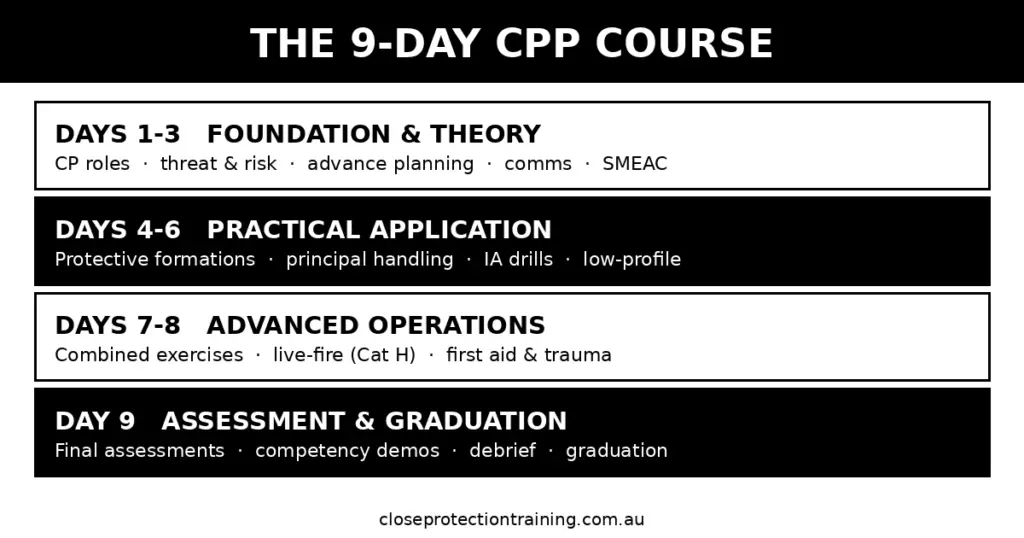
TL;DR: Panoptic’s Close Personal Protection (CPP) course runs for 9 days on the Gold Coast. You live on site. It has four stages: theory (days 1–3), practical skills (days 4–6), advanced work and live fire (days 7–8), and assessment (day 9). You finish with four nationally recognised qualifications.
What happens during the 9-day Close Personal Protection (CPP) course?
The CPP course is a 9-day live-in program on the Gold Coast. You start with theory in days 1–3. You move to hands-on drills in days 4–6. Days 7–8 cover advanced operations and a live-fire range. Day 9 is your final assessment and graduation. You leave with nationally recognised qualifications and a graduate certificate. This is close protection training for people who want real bodyguard and dignitary protection skills.
It is a learn-then-earn path. Graduates join the Panoptic Pathways alumni network. This gives you ongoing training and industry updates. Any work offered later depends on how you perform. We mark each student against a set rubric. The course does not promise you a job.
How is the course set out, day by day?
The course builds step by step. There is a fitness check before it starts. Each morning begins with combatives physical training (PT).
- Before you start — fitness check. Running, swimming, carrying loads, and strength and endurance. Each is tested against a set standard.
- Days 1–3 — theory. First aid and trauma care. Close protection roles. Threat and risk assessment. The live-fire range (Category H firearms). Advance planning and reconnaissance. Venue and route choice. Radio and comms. SMEAC mission planning.
- Days 4–6 — practical skills. Protective formations. Handling the principal. Immediate action drills. Low-profile work. You run these as live scenarios across the Gold Coast.
- Days 7–8 — advanced operations. Team exercises. Full planning tasks. Longer scenarios. Live fire and trauma care under pressure.
- Day 9 — assessment. Final tests, a debrief, graduation and certificates.
What does a normal training day look like?
This is not a classroom course. You live on site. Meals and a bed are included. The days are long. They start early with combatives PT. Then you train and run scenarios. Expect to finish each day tired, in body and mind. Living on site helps the team bond. It also lets you focus on the training. The course ends with a team dinner and awards. Not sure how fit you need to be? Read how fit you need to be for CPP training.
What qualifications do you get?
You must meet every standard to pass. Graduates earn four credentials. First, a Certificate III in Close Protection Operations. You need this for a bodyguard licence in Australia. Second, an Advanced First Aid certificate with TCCC and trauma training. Third, a Firearms Safety (Category H) certificate. Fourth, the Panoptic CP Graduate Certificate. Asset College (RTO 31718) issues the nationally recognised parts. Want the full list? Read what qualifications you need for CPP work in Australia.
Do you need experience to keep up?
No. You do not need experience to start. The course suits new people. It also suits skilled operators who want to fill gaps. A background in the military, police or emergency services can help. But it is not required. Our instructors come from the SAS Regiment, Commandos, Military Police close protection and Police Tactical Groups. Still deciding? Read how to become a CPP operative in Australia and how much CPP training costs.
Where do graduates work?
Panoptic is based on the Gold Coast. That is where we run the course. Our graduates work right across Australia. This includes Sydney, Melbourne, Brisbane, Perth and Adelaide. It also includes the Sunshine Coast, Newcastle, Wollongong, Geelong, Darwin, Katherine and Townsville. There is close protection and bodyguard work near many defence bases and police hubs. The skills also suit dignitary protection and hostile-environment roles overseas.
Key takeaways
- The CPP course runs 9 days, live-in, on the Gold Coast.
- It has four stages, from theory to final assessment.
- Meals and a bed are included. Days are long and hard. Each starts with combatives PT.
- You train in formations, drills, low-profile work and live fire (Category H).
- Graduates earn four nationally recognised qualifications through Asset College (RTO 31718).
- You do not need any experience to start.
Want to see if you fit the next intake? Book your place on the Close Personal Protection (CPP) course.
