
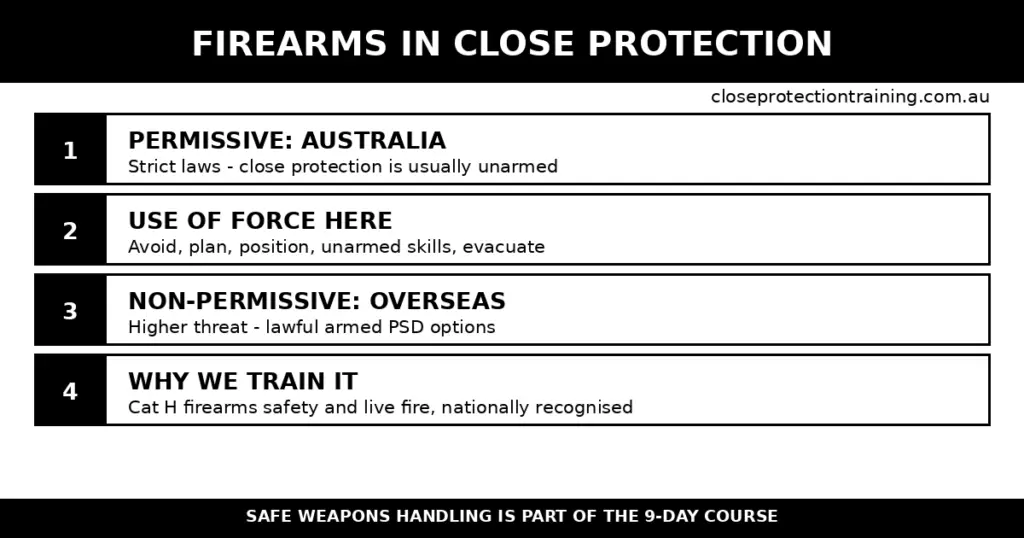
Short answer: In Australia, close protection work is mostly unarmed. Firearms laws are strict, and Australia is a permissive (lower-risk) environment. So operators here rely on planning, positioning and unarmed skills, not guns. Overseas non-permissive work can be different, with lawful armed options. That mix is why Panoptic’s course includes a Category H firearms safety package. It all starts with the 9-day Close Protection Operatives Course.
What is a permissive environment?
A permissive environment is a stable, lower-risk place with strong rule of law. Australia is one. Threats still exist, but they are lower and the law is tight. In this setting, most close protection (bodyguard) work is done without a firearm. The focus is on avoiding trouble, not meeting it with force.
What are the firearms rules for close protection here?
Australia has strict, state-based firearms laws. A handgun is a Category H firearm. To hold one, you need the right licence and a genuine reason. Armed close protection roles are tightly controlled and rare. Most operators here are not armed on the job. Always follow the law in your own state. Never assume you can carry. This is a legal question first, not just a training one.
What use-of-force options do operators rely on here?
Because guns are rarely an option, good operators plan to avoid force. The main tools are:
- Avoidance. Plan routes and venues to steer clear of risk.
- Advance work. Check sites early and spot problems first.
- Positioning. Stand and move to shield the principal.
- Unarmed skills. Control and separate, only as a last resort.
- Evacuation. Get the principal out fast and safely.
- First aid. Treat injuries until help arrives.
The goal is simple. Keep the principal safe and out of trouble in the first place.
How is a non-permissive environment different?
A non-permissive environment is high-risk. Think conflict zones or unstable regions overseas. Here the threat is higher. And the lawful use-of-force options can be broader. Teams may be armed. They may use up-armoured vehicles. The rules depend on the country and the contract. This is where hostile-environment PSD work comes in. It needs more training and experience than domestic work.
Why does the Panoptic course include a firearms package?
Because a professional operator needs safe weapons skills, and a recognised qualification. Panoptic’s 9-day course includes a Firearms Safety package with a live-fire (Category H) range. Here is why that matters:
- It builds safe handling from the ground up.
- It gives a nationally recognised firearms safety certificate. This supports a firearms licence in any Australian state.
- It prepares operators for lawful armed roles and for non-permissive work overseas.
You learn the rules and the safety first. The course does not turn you loose with a gun in Australia. It gives you the base to work safely and legally, wherever the career goes. Qualifications are issued through Asset College (RTO 31718). Instructors come from the SAS Regiment, Commandos, Military Police close protection and Police Tactical Groups.
Where does this training lead?
Panoptic runs the course on the Gold Coast. Graduates work across Australia – Sydney, Melbourne, Brisbane, Perth, Adelaide, the Sunshine Coast, Newcastle, Wollongong, Geelong, Darwin, Katherine and Townsville – and overseas. Read how to get into the bodyguard industry and what qualifications you get.
Key takeaways
- Australia is a permissive environment with strict firearms laws, so close protection is mostly unarmed.
- Operators here rely on avoidance, planning, positioning, unarmed skills and evacuation.
- Non-permissive work overseas is higher-risk and can involve lawful armed options.
- Panoptic includes a Category H firearms safety package so operators are trained, qualified and ready for lawful armed and overseas roles.
Ready to build the base? Book your place on the Close Personal Protection (CPP) course.
